Moving Spine
Keeping Spines Moving: How a Balgrist and UZH Startup is Redefining Spinal Surgery
When spinal instability requires surgery, the standard answer has long been fusion: screws, rods, and the permanent loss of motion in the affected segment. This “standard of care” is associated with a 15-60% complications rate. Moving Spine AG, a University of Zurich startup rooted in clinical research at Balgrist University Hospital, is challenging that paradigm with a fundamentally different approach.
The technology, called Vertebropexy, was conceived by Prof. Mazda Farshad, Medical Director and Surgeon-in-Chief at Balgrist, together with co-founder and CTO PD Dr. Jonas Widmer and the Spine Biomechanics group. Rather than rigidly fusing vertebrae, Vertebropexy uses ligamentous reinforcement to stabilize the spine while preserving natural motion. The result is a minimally invasive procedure that can be performed directly after a decompression surgery, reduces recovery times, and keeps all conventional treatment options open for the future.
What makes Moving Spine AG's innovation translation strategy unique is the speed and discipline with which the team is converting research into clinical reality. CEO Elmar Zurbriggen brings over 25 years of spine and orthopedics leadership, including senior roles at Synthes and DePuy Synthes, and leads a team of more than 11 professionals spanning R&D, regulatory affairs, and clinical validation. The philosophy is deliberate: bring together surgeons, engineers, and experienced medtech developers under one roof to accelerate the path from lab to patient, without compromising on safety. The facilities of Balgrist Campus and OR-X provide an ideal environment for exactly this, offering world-class infrastructure for testing, surgical training, and iterative refinement at every stage of development. Moreover, Moving Spine is highly networked within the Swiss Medtech Supplier Industry, which helps to focus on innovation and patient solutions.
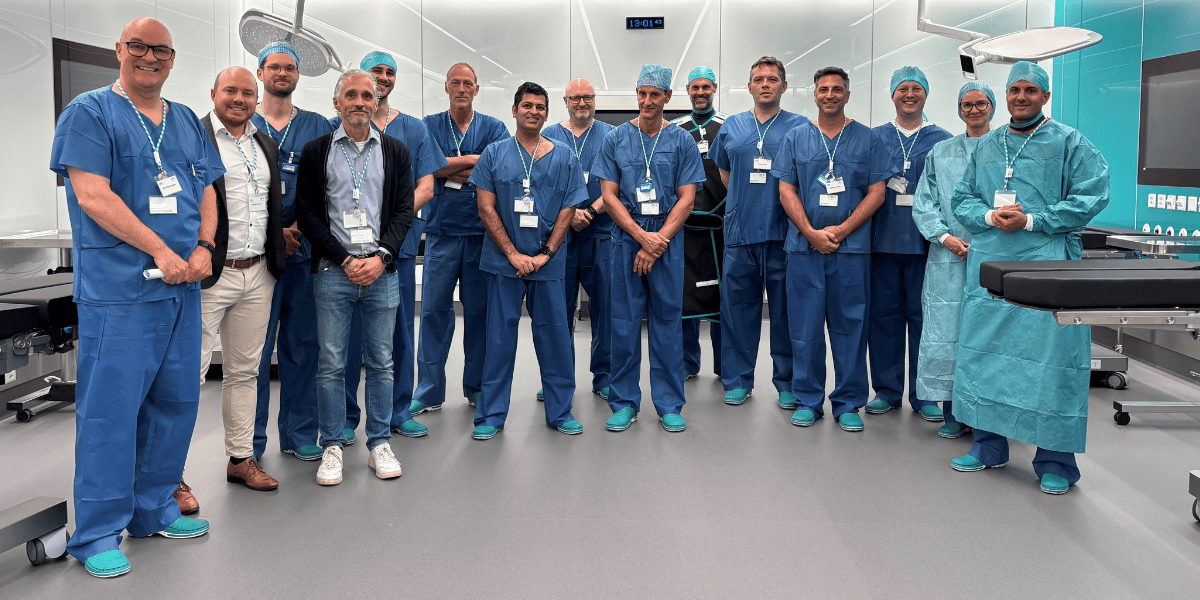
At the same time, Moving Spine actively integrates the international spine community into its development process. The company works with an international advisory board and regularly conducts wet labs with surgeons both in Europe (OR-X) and in the United States (Los Angeles). This continuous exchange ensures that the technology is shaped by broad clinical input and achieves strong support and validation across the global spine community.
Balgrist surgeons and colleagues support that journey through the IDEAL framework, aligned with the ethical committee: a rigorous, five-stage pathway purpose-built for evaluating complex surgical innovations. Moving Spine's work progresses from early proof-of-concept and first-in-human case reporting, through iterative development and multi-center exploration, toward formal comparative trials and long-term outcome surveillance. This structured approach ensures that each incremental advance is evidence-based and that patient safety governs the pace, not commercial pressure.
Far from slowing progress, this disciplined approach is precisely what establishes the clinical credibility required to introduce a truly new treatment category into mainstream spine care - despite strong, economically driven resistance from established spinal fusion companies.
Moving Spine is not just building an implant. It is redefining how spinal disorders are managed: offering patients a motion-preserving alternative that may delay or prevent the need for more invasive fusion surgery altogether.
Moving Spine is a Spin-off of the University of Zurich.